

Democrats achieved their “blue wave” in the midterms, striking fear into the heart of AI stocks and changing the fate of Social Security with implications for dentists’ saving and retirement plans.
Volatility around elections
The month before elections is typically volatile for markets, and this season was no exception. Stocks that have done well this year (AI-related) did poorly; stocks that underperformed (bread-and-butter stocks) did well, and many moved dramatically. Although a post-election return to certainty is usually healthy for stocks, local efforts to shut down data center construction coupled with pre-existing AI-related fears mean the selling might not be done just yet.
After shedding 2.7% in the third quarter, the Dow Jones was up in the month before the election. Semiconductor stocks, the core beneficiaries of the AI craze, dropped 11% in the third quarter, before dropping another 20% in the month before election day, and another 14% in the two days after. Many factors fed into this: concerns about the AI craze being a bubble, angst about rising interest rates, fears that Democrats would be less friendly toward AI than the current administration, and a growing sense that it will be difficult to follow through on the spending plans articulated by many AI companies.
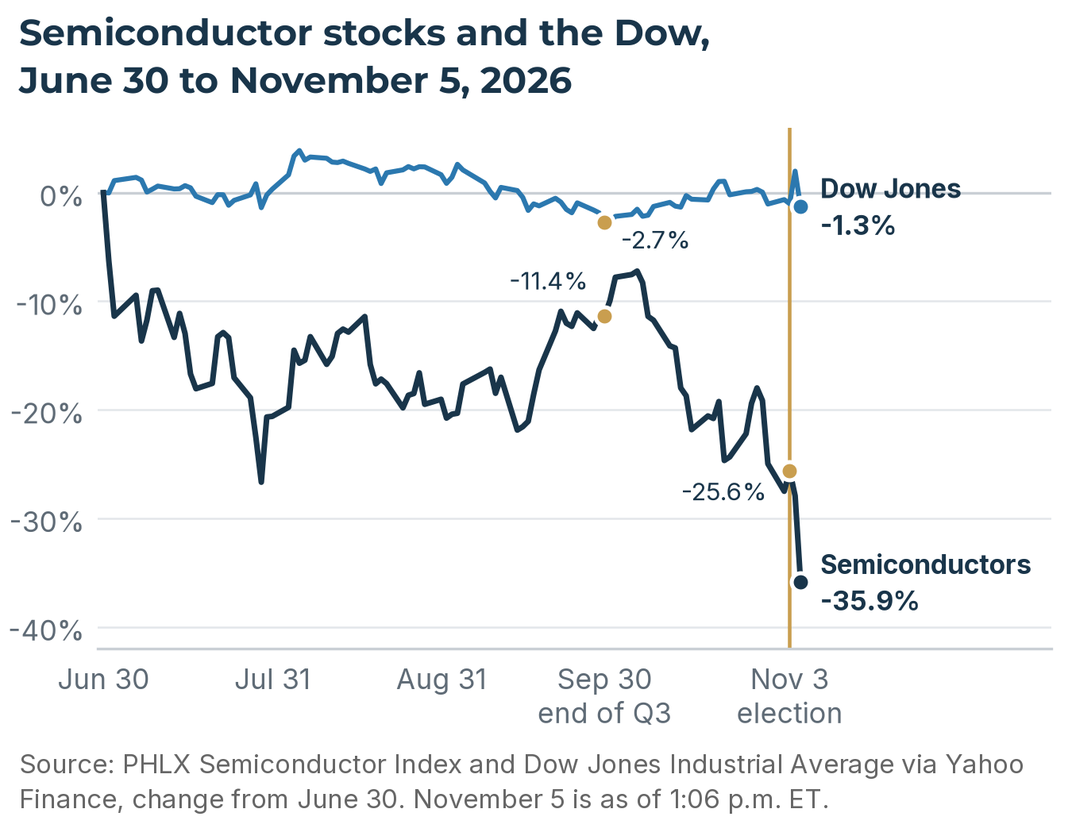
The technology behind AI is very real and very impactful, even if the onramp for productivity gains proves longer than hoped. The election has thrown a wrench into some of these plans, though. On a federal level, Democrats are unlikely to stand in the way of this powerful new technology. Despite the occasional fringe politician’s performative opposition, AI is as much a national security concern, considering China is number two in the space, as it is an economic concern. For better or for worse, the country has put its chips on the table for AI, and if it works, Democrats stand to benefit as much as anyone.
All eyes on the local election results
The Democratic sweeps in the localized elections are a different matter, though. Their focus is less on the broader economic or national security considerations, and more on the whims of the electorate. Although the litany of reasons to oppose data center construction is largely hyperbole and misunderstanding, explaining the nuanced tradeoffs of change has never been an easy task with the public. One of the benefits of the American system of government is our checks and balances impair dramatic, impulsive responses, giving change more time to sort itself out without interference.
Local governments can and do move faster, though. This might be bad news for many data center projects, with an estimated 45% of planned data center capacity in the United States landing in states likely to tighten the rules. In cases where data center construction bans outright were on the ballot, they mostly passed across the country. This is yet another case where Americans want the benefits of the technology, they just don’t want to deal with it in their backyard.
If planned data center construction is meaningfully interrupted, this will have negative consequences for the AI companies that were previously the most popular, the ones building the “shovels and pick axes” of the new world. In a theme eerily reminiscent of the dot-com era, some of the most popular stocks in recent years have been the ones responsible for the infrastructure buildout. Although they are not that expensive by most measures if their predicted earnings match reality, a change in plans on the part of data center construction would undermine those predicted earnings, throwing the question “are these stocks expensive or not?” into the air.
Instead, the anticipated winners will be the actual owners of compute. Until now, these companies have been somewhat punished because they are borrowing lots of money to acquire computing power for a still largely unproven technology. If the amount of planned computing capacity suddenly drops, realized computing power becomes more valuable, benefiting those companies that have it.
What does this mean for your portfolio?
The semiconductor stocks that have been the primary beneficiaries of the AI trade to date are historically inexpensive if compared to their expected earnings, but the future realization of those earnings is rightfully in doubt. Many people that own these stocks have unwittingly found themselves overweight on account of their strong moves up; that overweight may have helped before, but it might hurt going forward.
Although we are not obsessive about rebalancing, we also don’t believe in looking at a gift horse in the mouth. There are many good companies that are still moderately priced, and many more that – if AI works – will benefit immensely from its real-life deployment, even if that is still years away. If the money made on strong moves up in AI stocks is an essential part of your retirement, it is better to capture the gains and diversify than risk giving it back.
Implications for Social Security, dentists, and retirees
The scope of Democratic wins was dramatic. So dramatic that the Republicans are unlikely to retake the House before 2030 or the Senate before 2032. Chances are the Democrats will at least control the Senate when the task of fixing Social Security stops being optional around 2032.
Given a time machine, it’s likely Republicans and Democrats would gladly travel back to the Bush administration and accept his 2005 proposal to overhaul the program. The modest changes proposed then would have, in hindsight, solved most of the program’s funding problems. Alas, messing with Social Security is the third rail of politics, and his suggestion never received the consideration it deserved.
Because we will be waiting until the last minute to implement a fix, the scale of the changes will be greater and the pain more pronounced. The alternative to a fix will be an immediate reduction of about 22% in benefits for all Social Security retirees, making the pressure to implement changes immense. There are a finite number of options to fix the program, and most were either examined or implemented last time we were in this mess in the early 1980s.
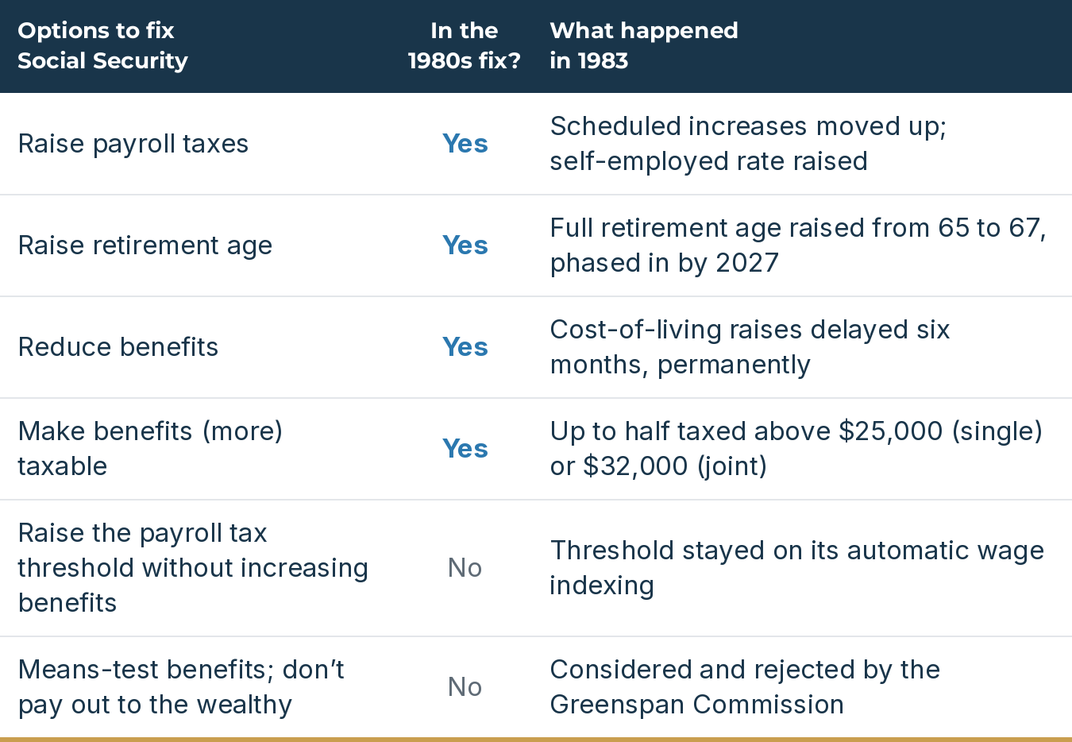
Each of these options is painful for some group of people; they don’t impact all voting blocs to the same degree, making any fix a balancing act between where and upon whom to impose the most pain.
It is reasonable to assume that, with the Democrats the probable majority in the upper chamber, they will have an upper hand in the negotiations for the fix. Bearing in mind that unlike government shutdown standoffs, any party that allows benefits to get a haircut – even for a single payment – is likely to be severely punished, it is probable that some of the changes that disproportionately impact the wealthy are going to be given more serious consideration than they might have if Republicans had retained power.
This has meaningful implications for retirement planning for dentists, dental specialists, or anyone where the individual’s nest egg is going to be large enough to be considered wealthy by the average American, even if the ground-floor reality is less glamorous than it appears on paper.
A married couple planning on retirement income of between $10,000 and $25,000 per month, using a combination of their portfolio and Social Security, is relying on Social Security to cover a meaningful amount of it. High-income professions like dentistry will often result in Social Security payments near the maximum, making any reduction in benefits resulting from means-testing exceptionally painful.
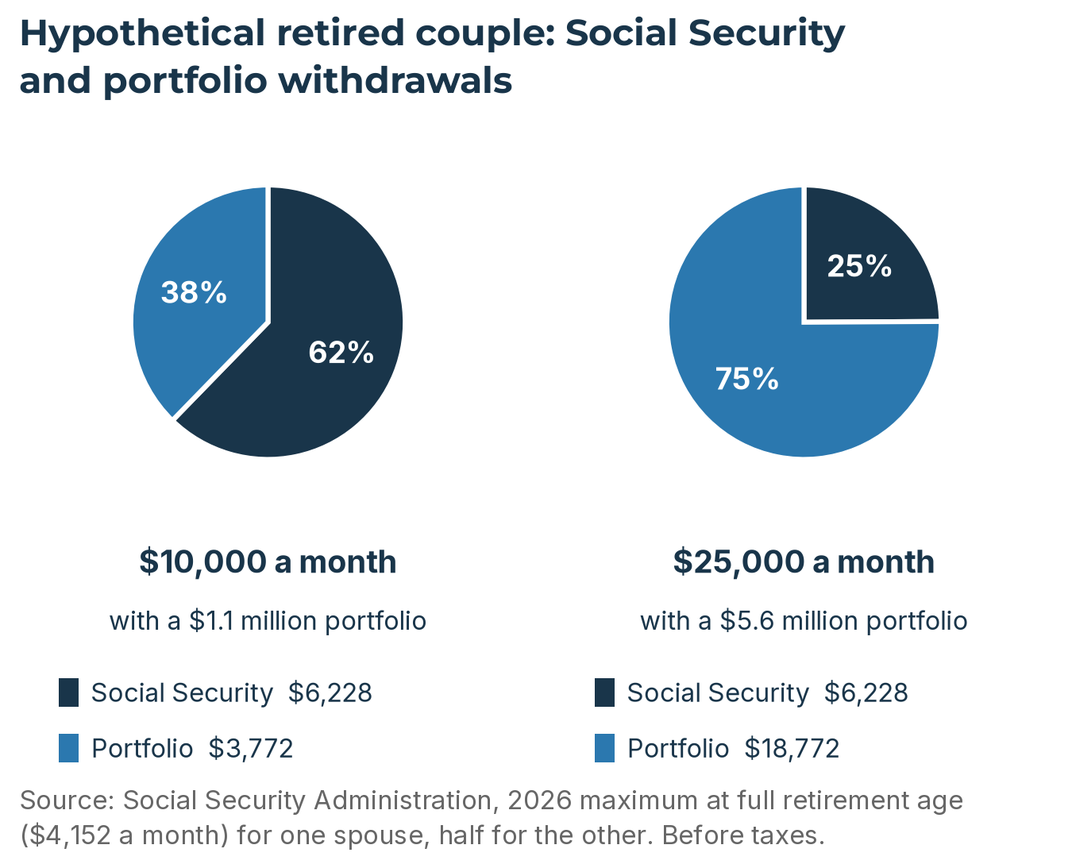
Those are the consequences for those already retired. For those that are saving aggressively in their final, high-income years, a hike in the payroll tax rate or, worse, the removal of the payroll tax limit could meaningfully reduce post-tax earnings available for saving.
This will increase the importance of already-smart tax saving moves by strong dental practices, such as ensuring you’re being taxed as an S Corp, capitalizing on profit sharing, and deploying cash balance plans to increase pre-tax saving. Until a Social Security fix is deployed, we can’t be sure what the solution will look like, but we can make educated guesses based on politics and public sentiment. We believe it is prudent for dentists to update their financial and retirement plans and savings plans in light of these developments; it would be better to err on the side of being conservative than to depend on a source of income or savings schedule that might not be available when it’s needed.
Alexander Shoker
Founder & Principal
Would you like to better understand how these developments impact your saving and retirement? Request a complimentary, no-obligation portfolio review.
Request your complimentary review
This material is for informational and educational purposes only and reflects our views as of publication, which may change. It is not a recommendation to buy or sell any security, and it is not individualized investment, tax, or legal advice. Investing involves risk, including possible loss of principal. Our Form ADV Part 2A brochure is available on request and at adviserinfo.sec.gov.