
Bond yields are rising: implications for your practice and retirement
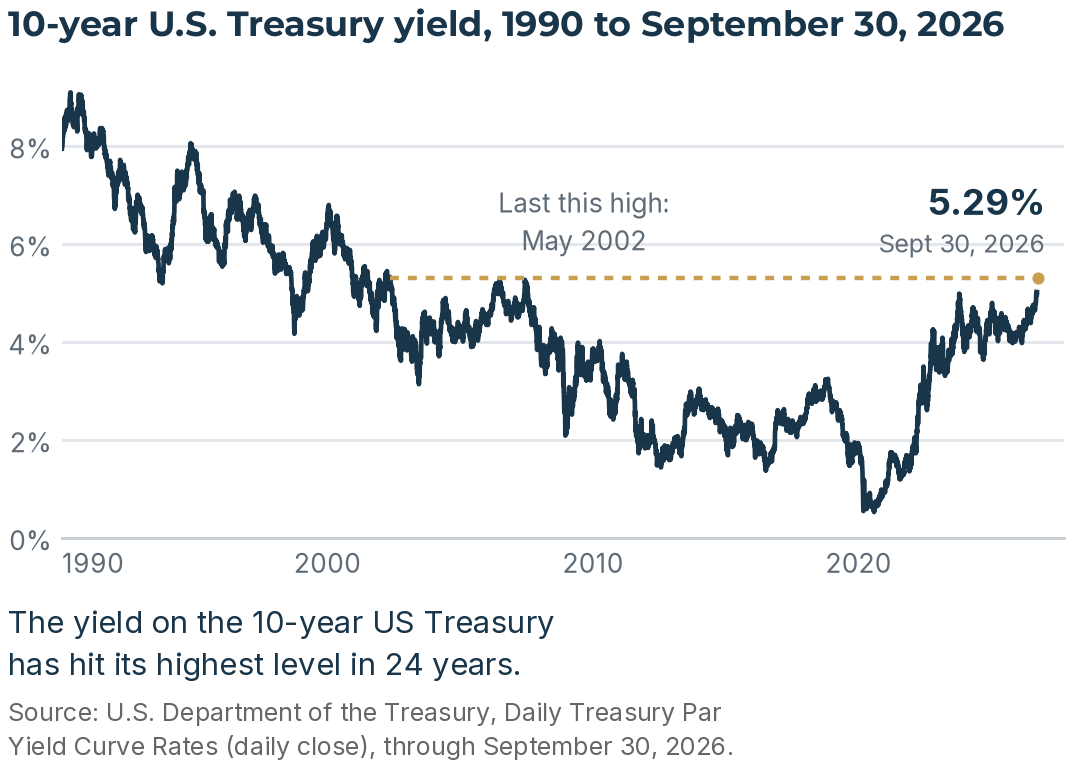
You may have seen the headlines: interest rates on long-term U.S. government debt have been climbing. The 10-year Treasury, an important point of reference for loans like mortgages, saw yields hit a 24-year high on Sept. 30. At 5.29%, this represents a dramatic change from early 2021, when it yielded just 0.93%.
This change has a few implications for dentists, both working and retired. The first is real estate prices, impacting building rent, buying or selling the building that houses your practice, and buying or selling your home. The second concerns practice sales; buyers needing loans will find their post-purchase take-home being squeezed by higher monthly payments. The third is higher borrowing costs on equipment purchases, and the fourth is better interest earned on cash reserves and fixed income in retirement portfolios.
Real estate
Although the impact may be delayed, elevated interest rates for extended periods of time will eventually surface in building rent rates. Landlords need to be able to service their loans while still turning a profit. Many will still have lower-rate loans from years ago, but as new loans are issued or refinanced with each passing month, more landlords will find themselves in the high-cost loan category.
If you own your building already and were hoping to sell it with your practice, you may want to have a plan for renting the building as a contingency. Your practice buyer may still be able to buy your building eventually, but the number of young dentists interested in taking on a loan to buy your practice on top of a loan to buy your building will be reduced with higher rates.
For home sales, elevated rates increase the size of monthly payments for buyers that need a mortgage, reducing the number of people that can afford your home. If you plan on downsizing and buying your next home in cash when you retire, this can make it easier for you as a buyer, but potentially more challenging as a seller.
Practice sales
Practice sales themselves may come a little bit slower. Although practice loans enjoy reasonable rates compared to other types of borrowing, upward pressure on rates everywhere will still leave its mark. Practices in slower-growth areas will see this more than practices in growing areas. Whether a younger dentist wants to live in the area where your practice resides matters; highly desirable locations will still do well in higher-rate environments, but more rural practices may start to feel pressured on price if rates stay elevated.
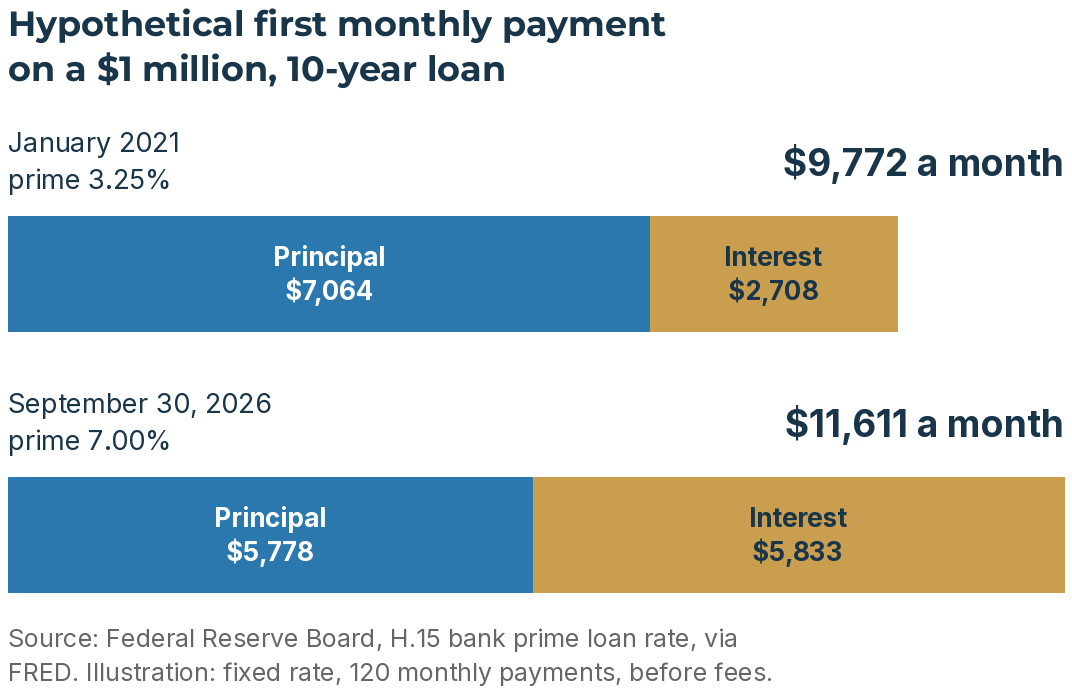
Besides a price cut, there is nowhere else for the money to cover these extra payments to come from except the new owner’s take-home. An associate that is making good money right now will find the math to switch to an owner less appealing the higher rates go. A hypothetical 10-year $1 million loan illustrated below shows how much has changed for buyers and sellers in just a few years.
Equipment purchases
In low-interest rate environments, it can make more sense to lean on credit and finance more purchases so you can try to keep more cash invested in stocks. As rates climb, the math behind these decisions begins to shift. It may make more sense to save, keep more in reserves, and make more purchases in cash or with smaller loans than it did a few years ago.
Cash reserves and fixed income
Not every aspect of higher rates is negative. Although the terms are intimidating at first, buying at higher rates can be desirable as it tends to slow down price increases and leaves room to refinance later if rates fall. Furthermore, essential cash reserves covering your personal life and practice can do more meaningful work for your portfolio, whereas only a few years ago cash earned almost nothing.
A $2 million retirement portfolio that is 70% stocks, 30% bonds was earning as little as $660 per year from short-term Treasuries a few years ago; this barely made a dent for retirees, meaning stocks were left to do most of the work. Now, that same portfolio pays over $29,000 per year.
Cash reserves enjoy a similar perk. Rather than earning barely above 0%, a $200,000 cash reserve now produces nearly $10,000 per year in interest. These are meaningful differences that can help change the math on when you can afford to retire, although reinvestment risk needs to be considered. The problem with bonds is they come due, and you have to buy new ones. If interest rates have gone back down, your income stream could change. Although interest from bonds is safer, dividends from stocks can sometimes be the more reliable long-term income producers.
What is causing this rise in rates?
Although often talked about as if they do, the Federal Reserve does not actually set interest rates, the market does and the Fed influences them. The current interest rate changes have been happening against the implied wishes of the government, and despite their efforts to slow it.
The Federal Reserve sets a target range for an overnight interest rate relevant to banks, and it makes use of a few other tools to influence rates, but neither translates into outright control. The US Treasury is trying to stem the tide by issuing newer short-term debt, buying back older long-term debt. Think of it like the government refinancing its debt, except instead of re-setting to a longer loan term like you or I would do, they are doing the opposite and making their loan terms shorter. Although these actions have an impact, market forces are proving to be stronger right now.
Many factors are contributing. The AI buildout is adding a lot of demand for financing, which means there is less available for governments to borrow. Quality tech companies that used to sit on piles of cash have suddenly flipped, and are now borrowing large amounts to finance data centers.
Government debt and spending are a big factor. Even though a record-breaking amount of interest is being paid to finance our national debt, discussions around fiscal restraint remain elusive. No national government can continue to borrow so aggressively without consequences, and higher interest rates are one of those consequences. That’s not to suggest this is just an American problem: the current interest rate moves are happening globally.
The money printer
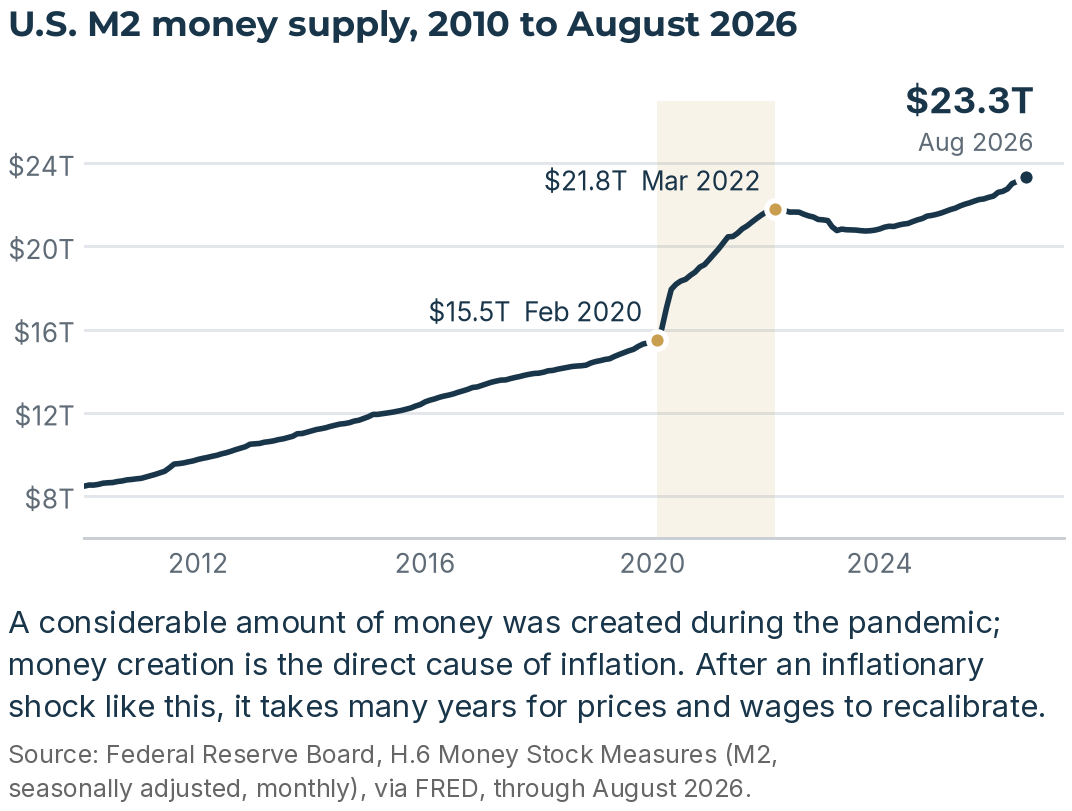
A deeper-rooted factor that will mess with rates for a while, still, is inflation. We had stable prices for many years after the financial crisis, but COVID-era financial decisions changed everything. Between February 2020 and March 2022, the U.S. money supply, measured by M2, increased from approximately $15.5 trillion to $21.8 trillion. Anyone that has played Monopoly should be able to tell you what happens if you suddenly gave every player a lot of extra money: the prices of all the property will go up accordingly. What is less obvious is that it takes a long time for the new price of Park Place to find equilibrium with the new price of Baltic Avenue. That equilibrium-finding process can result in ‘waves’ of inflation that don’t impact all areas equally or at the same time. It takes many years for prices to stabilize, and without that it’s hard for rates to stay low.
For a practice owner, these additional dollars contributed to the jump in dental supply costs, making dental services more expensive. Because some people consider dental services to be less essential than other expenses, this took some patients out of circulation that may not return until their incomes and expenses have normalized again. It just takes time and monetary stability to get back there.
For now, it would be a mistake to anchor ourselves to expenses, patient patterns, practice sale prices, or loan terms, or anything else considered normal as recently as 2021. Our new reality has a lot of extra cash in circulation, representing a more complicated problem than is generally discussed, and it changes things in unexpected ways on unexpected timetables.
Even if it does take many years to fix itself like it did in the 1970s and 1980s, remember, dental practices were still profitably bought and sold throughout that era despite the higher rates. Higher rates impact planning for your practice and retirement; it is something to plan around, not to worry about. That said, we can all hope for some monetary stability and consistency going forward.
Alexander Shoker
Founder & Principal
Complimentary, no-obligation portfolio review
We’ll give you our thoughts on your portfolio and financial plan.
Request your complimentary review
This material is for informational and educational purposes only and reflects our views as of publication, which may change. It is not a recommendation to buy or sell any security, and it is not individualized investment, tax, or legal advice. Investing involves risk, including possible loss of principal. Our Form ADV Part 2A brochure is available on request and at adviserinfo.sec.gov.